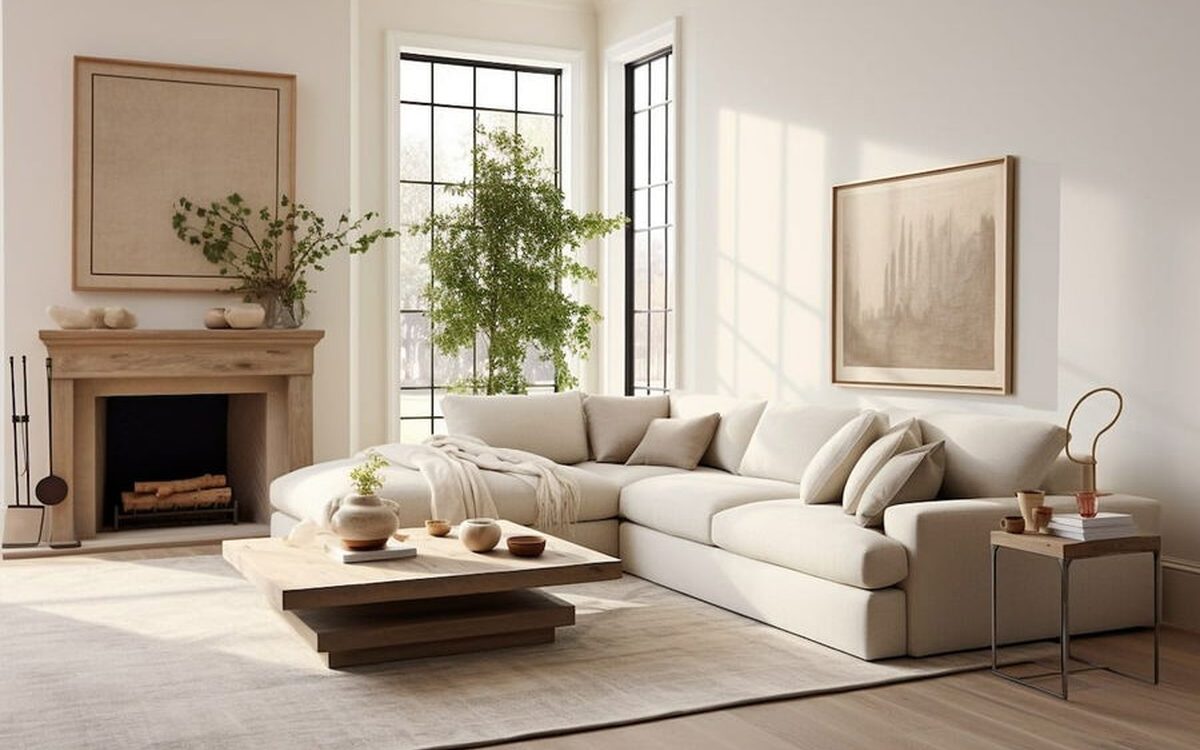
Warm minimalism is not an empty room. It is a room where every object has earned its place, and where the surfaces themselves — plaster, oak, linen, stone — carry the character instead of a dozen accessories.
The result is a home that feels quiet without feeling cold, and open without feeling staged. Here is how we approach it, room by room.
Texture over stuff
When you remove visual clutter, texture has to do the work. A room with plain walls, one sofa and a stone floor will feel austere. The same room with a limewashed wall, a boucle sofa, a nubby wool rug and a grained oak table feels generous.
- Choose materials you want to touch, not just look at.
- Mix scale: a chunky weave next to a fine one, rough plaster next to honed stone.
- Let a hero material appear more than once in the room so it feels intentional.
A palette with temperature
White is not the only option for a calm home. Warm neutrals — oatmeal, mushroom, clay, soft sage — read as restful and forgiving of real life. Build the palette from the largest surfaces down: floor, walls, then big furniture, then accents.
One word of caution: warm palettes need contrast or they drift. A deep olive door, black metal fixtures or a dark timber island gives the eye somewhere to rest.
Light as a material
Light is the most underrated finish in any renovation. Plan layers rather than a single ceiling fixture: ambient, task and a low pool of evening light. Put dimmers on everything you reasonably can.
- Keep window treatments simple so daylight stays generous.
- Use warm lamps at low level for evenings — a room changes personality entirely.
- Wash texture with light: a wall-light grazing plaster is worth the effort.
Furniture that can be moved
A quiet home still has to host a birthday, a work call and a rainy afternoon with children. Choose pieces that can be rearranged without a plan: a light coffee table, side tables that double as stools, a sofa that does not insist on facing a television.
Leave breathing room around the edges. Space between furniture is not wasted — it is what makes a room feel unhurried.
Storage you do not see
Minimalism fails without storage. Build it in: a bench with a lift-up lid, drawers under the stairs, a tall shallow cupboard for the things that otherwise live on surfaces. Then give each room one visible, beautiful moment — a bowl, a plant, a piece of art — and let the rest disappear.
Kitchens and bathrooms: let the hard surfaces speak
These are the rooms where material quality is felt daily. A simple kitchen in honest oak and stone will outlast a busy one in glossy finishes. In bathrooms, a single tile carried from floor to wall with careful grout lines looks more considered than a mosaic of ideas.
Room by room, without starting over
Warm minimalism can be layered into an existing home. Begin with the room you use most, remove what does not belong, and reinvest in one or two textures that will change how the space feels. Then repeat, slowly, as budget and patience allow.
If you would like a second eye on the palette or the layout, our design team would be delighted to help.